

WE PIONEER EDUCATION - INQUIRY BASED LEARNING
Children are naturally curious. Inquiry-based education works with a child’s natural curiosity and desire to follow their interests, to experiment and to be involved. Critical thinking, problem-solving, and self-direction are critical skills in today's world. Our inquiry-based program develops those skills through progressively more challenging inquiry units as students progress through grades.
Compelled by curiosity, RVC students delve deep into questions that are important to them. Students are engaged in their learning and motivated to increase their own knowledge through discovery. With the focus of a guiding question, students are provided with resources, support, and direction while they work to experiment, research, and learn.

Inquiry Arcs
Throughout the school year, RVC students experience several distinct 6-10 week ‘Inquiry Arcs.’ Each arc follows an intentional process that provides students with background knowledge, while igniting each child’s curiosity to develop their own knowledge, culminating in them sharing what they’ve learned.
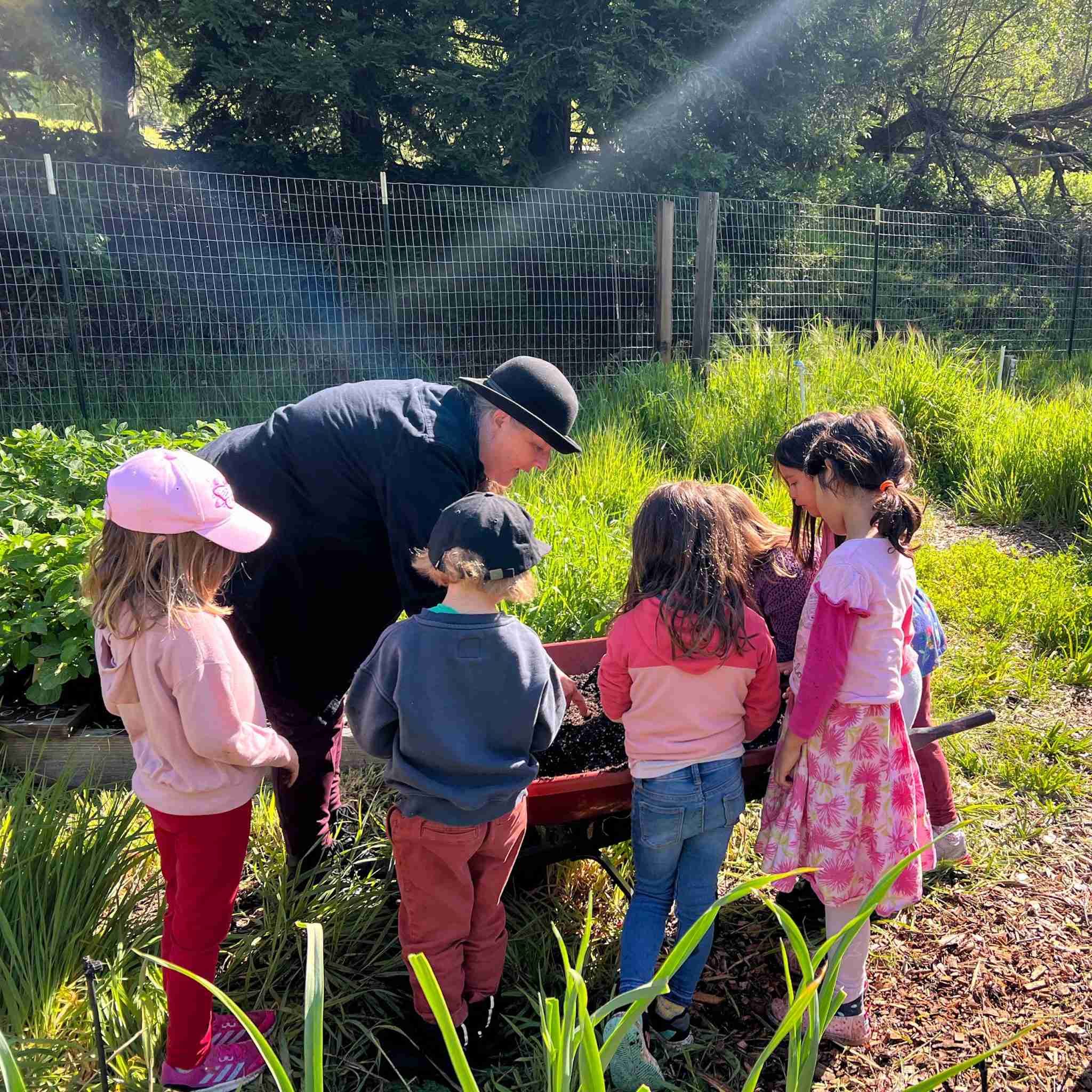
Phase 1: Exploration
The “exploration” phase includes teacher-led lessons, observations, field trips, talking with experts, and reading informational books, articles and websites. Students wonder, notice, ask questions, make predictions, test hypotheses and become immersed in a topic.
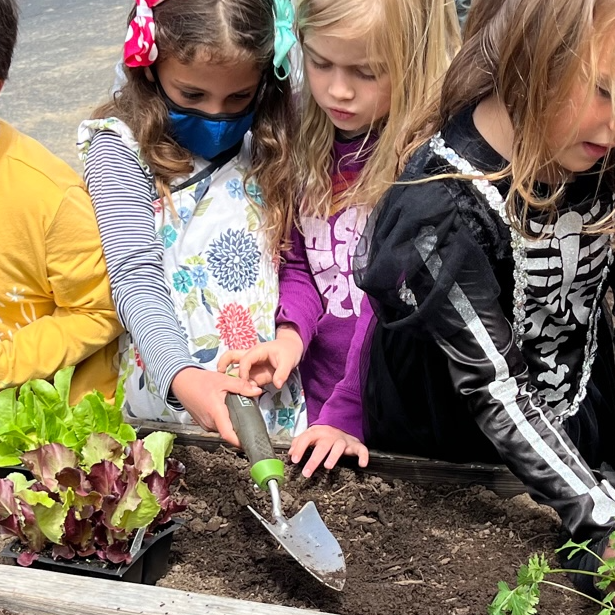
Phase 2: Investigation
In the next phase, called “investigation,” students discuss as a class what further questions they have about the topic. Sometimes, they reach consensus on a guiding question to answer about a subject. Other times, individual students, partners, or small groups work on a question together. As the inquiry progresses, students use a variety of resources to collect and record data, represent and explain results, and develop a meaningful body of work around the inquiry topic.
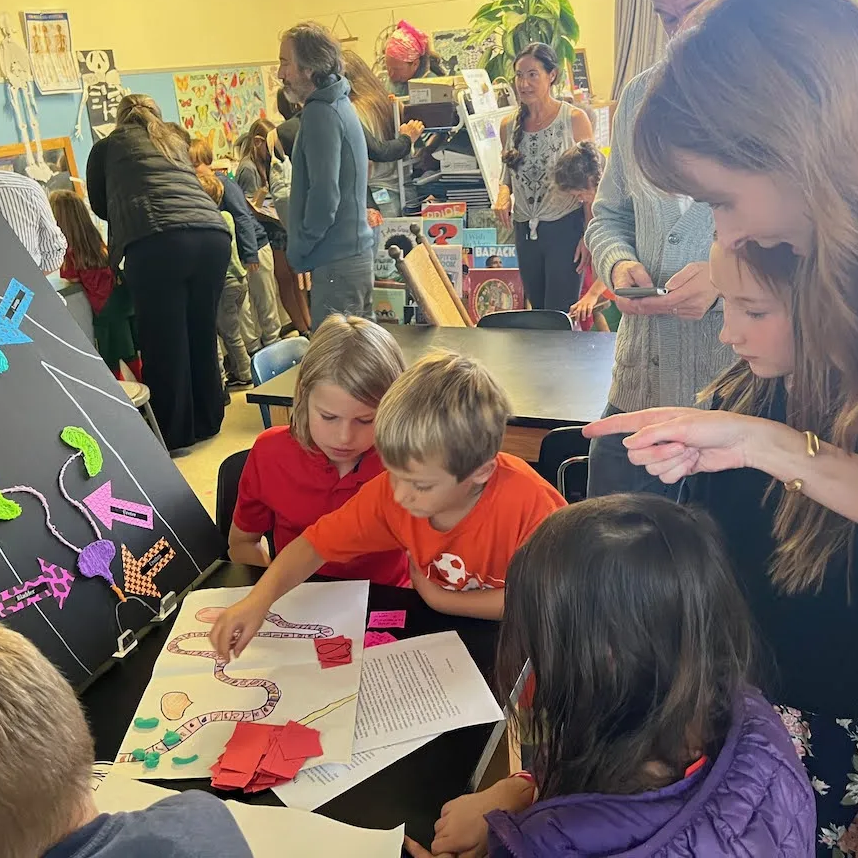
Phase 3: Exposition
In the final phase, “exposition,” students determine how to share their knowledge with others. This may include performances, written papers, and living museums all guided and produced by students. Students develop skills and strategies to share their understanding with a wider audience, gaining confidence and pride as they demonstrate their accomplishments by teaching others. Following each arc, students follow a guided reflection both on their learning and on the inquiry process.
The program at Ross Valley Charter began in the tradition of progressive education. According to Alfie Kohn, renowned expert on education, schools that practice progressive education incorporate these eight important components: attending to the whole child, community, collaboration, social justice, intrinsic motivation, deep understanding, active learning, and taking kids seriously.
With inquiry-based learning, the components of progressive education are incorporated into the inquiry process. Inquiry-based learning generates engagement in students so that neurons begin to fire, curiosity is triggered, and they want to become experts in answering their own questions. This approach to learning emphasizes the student’s role in the learning process. Rather than the teacher telling students what they need to know, students are encouraged to explore the material, ask questions, and share ideas.
Inquiry-based learning uses different approaches to learning, including small-group discussion and guided research. Instead of memorizing facts and material, students learn by doing, creating, and then teaching their knowledge to others. This allows them to build deep knowledge and understanding through exploration, experience, and discussion.
Social and emotional learning, arts-integrated education, visual arts, music education, spanish-language education, physical education.
The California Assessment of Student Performance and Progress (CAASPP) tests and the California Science Test (CAST) are given each spring and are a standardized measure of how students are performing. We are currently analyzing our 2023-2024 CAASPP and CAST data to share here soon.
Yes, as a California public school, Ross Valley Charter uses the Common Core State Standards, which are woven into the students' inquiry explorations. RVC is also required to hire classroom teachers with California teaching credentials, and RVC students take State standardized tests.
Students’ ongoing classwork and projects are assessed to show academic growth and progress toward Common Core State Standards, which reflect the importance of 21st Century skills such as problem solving, collaboration, and communication.
Curriculum rely heavily on project- and problem-based learning, long-term units of study integrating many curricular areas, going in depth and examining a topic from many angles, and increasing students’ engagement and interest.
Please contact our office for an indepth overview of our curriculum.
Typically each student will recieve homework from their grade teacher on Mondays and homework will be due that weeks Friday. Each classroom teacher will provide their exact homework schedule with you at the beginning of each school year.
At RVC, our inquiry-based learning approach provides a creative and engaging environment that is not focused on test scores. Our students learn to collaborate, ask questions, and express their knowledge in different ways, while teachers engage students’ natural curiosity and desire to learn. This approach lets students build skills that standardized tests don’t measure — the behaviors, attitudes, and social-emotional skills that set students up for success in school and in life. And clearly, in taking a test.
Inquiry-based learning emphasizes student-driven exploration and problem-solving, fostering critical thinking through questioning and investigation. Waldorf education integrates a holistic approach, focusing on artistic, practical, and academic development with a strong emphasis on imagination and rhythm. Both encourage active learning but differ in their methodologies and focus areas.
RVC is committed to an inclusion approach for children with special educational needs. RVC’s full-time, credentialed special education teacher is a part of our teaching team delivering these services in the context of RVC’s overall child-centered approach and in collaboration with the general education teachers to support each child’s particular needs and abilities.
RVC is a member of the El Dorado County Charter SELPA. The SELPA is a consortium responsible for the development of special education policies and procedures, distribution of federal and state special education funds, and providing a range of professional development pertaining to special education. With this support, the Charter SELPA’s partners continue to demonstrate the capacity to provide high-quality special education programs to their students.The proportion of special education students in public charter schools and non-charter public schools throughout California is equivalent.